
Life is a Gift
The very fact that we are alive is extraordinary. Out of millions of possibilities, you were born. Our ancestors endured wars, hardship, and trauma, yet life was passed on to us. Even if we carry our own wounds, we have survived. Seen this way, life itself is a miracle.
Understanding Systems
Family Constellations reminds us that life is precious — and that we are part of larger systems. Just as the body is made of interconnected parts, each of us belongs to a family, a community, and a society. Every part matters. When someone is missing, excluded, or out of place, the system is thrown out of balance.
The Orders of Love
Psychotherapist Bert Hellinger described the natural order within families: grandparents come before parents, parents before children, and so on. When these “Orders of Love” are disrupted — for example, when a child takes on a parental role — the whole system feels the strain.
How Family Constellations Works
Family Constellations is an embodied, experiential approach. In a supportive group setting, we explore hidden dynamics by stepping into representations of family members. Through movement, feeling, and shared insight, we uncover unspoken truths, unprocessed trauma, and pathways to restored connection.
The Knowing Field
Working within what Hellinger called the “Knowing Field” (and Rupert Sheldrake termed it the “morphogenetic field”), participants often sense emotions and perspectives of family members — whether living or deceased. This collective exploration reveals how deeply connected we all are and opens the way to healing.
“Accepting your fate is not enough. You must agree to it. If you are able to face up to your fate with humility, you gain strength.“
Bert Hellinger

What happens in a Family Constellation?
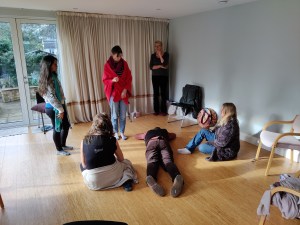
Family Constellations is a therapeutic approach developed by Bert Hellinger that aims to address and resolve issues within a family system. It is often used to explore and understand underlying dynamics, unresolved conflicts, and hidden loyalties within a family that may be causing emotional and psychological distress. Here’s what typically happens in a Family Constellation:
- Setting: Family Constellations are usually conducted in a group therapy setting, although individual sessions are also possible. The facilitator, often called a “constellator,” guides the process.
- Representations: Participants, including the client and sometimes other group members, are selected to represent family members and significant figures related to the client’s issue. These representatives stand in a physical arrangement in the room, forming a “living sculpture” of the client’s family system. In a 1:1 setting, floor markers are used as representations.
- Unconscious Dynamics: The constellator and the participants begin to interact within the constellation. Through a process of guided intuition, participants may begin to feel and express emotions, thoughts, or physical sensations that are not their own but represent the feelings and experiences of the family members they are representing. This can reveal unconscious family dynamics and hidden loyalties. In a 1:1 setting it is the client who steps into representations (floor markers), and the facilitator can also represent.
- Reveal and Resolve: The constellator observes the dynamics within the constellation, looking for entanglements, unresolved conflicts, and imbalances. The goal is to bring these issues to light, acknowledge them, and ultimately find ways to resolve or release the entanglements.
- Reconfiguration: Through various interventions and movements within the constellation, the constellator works to reconfigure the representation of family members to create a more balanced and harmonious system. This may involve changing the positions and orientations of the representatives to address the underlying issues.
- Insights and Healing: The process often leads to insights and a deep emotional release for both the client and the representatives. By addressing and acknowledging family dynamics, it is believed that healing and resolution can occur.
- Integration: After the constellation process, the client and the participants are encouraged to reflect on their experiences and insights. The client can then work on integrating these insights into their life and making positive changes based on what they have learned.
It’s important to note that Family Constellation is a controversial and unproven therapy, and its effectiveness is a subject of debate among mental health professionals. While many people have reported positive experiences and outcomes, there is limited scientific evidence to support its claims. In the science of Epigenetics it has been found that trauma as well as resilience can be inherited. Nevertheless, anyone considering Family Constellation therapy should exercise caution and carefully research the practitioner’s qualifications and approach. Additionally, it’s a good idea to consult with a licensed mental health professional before pursuing this therapy to ensure it is appropriate for their specific needs and concerns.
My next workshops will take place in 2026, 10 am – 6 pm (21 Mar, 27 Jun, 26 Sep), at a beautiful private venue in Headington near Brookes University (the Oxford Tube coach from London stops nearby).
To book, please click HERE.
Checkout issues? Book here.If you would like me to facilitate a 1 or 2 day workshop for a group of minimum 6 participants, you are welcome to get in touch with me.
 Silvia Siret - Family Constellations Life Coach